
Can Nature Really Help Us Focus?
What the Science Says and Why We May Be Asking the Wrong Question

It is becoming harder to keep our attention from slipping.
To read a page without drifting, to follow a conversation without losing the thread, to finish a piece of work without interruption.
A survey from King’s College London found that one in two people feel their attention span is shorter than it used to be. And this isn’t limited to any one age group, but is reported across all stages of life.
A patient I once worked with told me:
“When I try to focus for more than a few minutes, I feel a kind of pressure building in my head.”
That image of pressure building has stayed with me. Something about the way we live seems to be making attention not only fragile, but at times almost unbearable.
We often respond by trying to outsmart the problem with new hacks: productivity apps, smart timers, the latest techniques to help us concentrate for longer.
But some researchers are turning to something that has been there all along: nature.
What the Evidence Shows
In one study, participants were randomly assigned to one of two groups: a 50-minute walk either in a tree-lined park or along a busy urban street. After the walk, they completed a memory task. Those who had walked in nature improved their performance by around 20%, while those in the urban condition showed no change.
And when the same experiment was repeated with people experiencing depression - a condition associated with difficulties in concentration - the improvement was not only replicated but five times larger. In other words, time in nature didn’t just improve performance but had its strongest effect in those who needed it most.
Further research has shown these improvements are not just behavioural, but also visible in the brain. In one study, participants completed a mentally fatiguing task and were then sent for a 40-minute walk in either a natural or urban setting. Afterwards, the researchers asked participants to complete a task which required prolonged attention and measured their brain activity using electroencephalography.
Only those who walked in nature showed a boost in a specific brain signal called the error-related negativity. This signal, which happens just milliseconds after we make a mistake, is the brain’s way of detecting errors and helping us correct them. A stronger error-related negativity means our brain is more alert and better at detecting mistakes, adjusting, and staying on track over time. In other words, a walk in nature gave the brain a noticeable boost, sharpening mental focus in ways that an urban walk couldn’t match.
Even Small Moments Make a Difference
We might think these benefits require long walks in remote landscapes. But the evidence suggests otherwise.
In a classic study, students living in dormitories performed better on attention tasks if their windows overlooked natural scenes rather than built environments. Even a glimpse of trees seemed to help. Subsequent studies have found that:
Listening to birdsong for short periods can improve concentration
Having plants in a room can enhance cognitive performance
Even watching images of natural scenes on a screen helps restore attention, although the benefits tend to be lower than those of real-life exposure
In one particularly striking experiment, 150 university students completed a demanding attention task. Halfway through, participants were given a 40-second “micro-break.” Half looked at a green roof covered in plants; the other half looked at concrete. When they returned to the task, those who had seen the green roof made fewer mistakes and were able to sustain their attention for longer than those who saw concrete. This suggests that even brief moments of contact with nature, lasting not hours but seconds, can restore our ability to focus.
How Does Nature Help?
One explanation is physiological.
Spending time in nature appears to shift the body out of a state of stress. Studies have shown reductions in blood pressure and skin conductance - markers associated with the “fight-or-flight” response. In other words, nature helps the body settle and this allows the mind to focus.
Another explanation is psychological.
According to attention restoration theory, natural environments engage our attention in a gentle, effortless way, allowing the more effortful form of attention we rely on for work and study to recover. Rather than demanding focus, nature seems to hold it softly, giving the mind a chance to rest and reset.
Of course, just as the body and mind are two aspects of the same whole, these may simply be two ways of describing the same process.

The Developing Brain
These effects may be even more important for children and adolescents.
We know that the brain develops gradually from birth to the early 20s, and that during this time it is highly sensitive to the environment. A growing body of research suggests that regular exposure to green spaces supports this development.
One study examined the benefits of green spaces around schools and homes in schoolchildren. The results revealed:
Improved attention
Less distractibility
Better working memory (the ability to hold and use information in mind)
Again, these effects are not just in the mind. When the same researchers also used brain imaging in a subset of the children, they discovered that those with greater exposure to green surroundings had larger volumes in several brain regions linked to cognitive control, including the left and right prefrontal cortex and cerebellar hemispheres.
There is also evidence that nature exposure is linked to actual academic performance. Schools surrounded by more greenery tend to have higher test scores, better graduation rates, and more students progressing to higher education. As one research team put it: high grades really do grow on trees.
What About ADHD?
These findings raise an important question: could nature help those who struggle most with attention?
ADHD affects around 7% of children and 2.5% of adults. While medications can be effective in the short term, they may come with side effects, and their long-term impact is still debated.
Several large studies suggest that growing up with access to green space may reduce the risk of developing ADHD. For example, research following over fifty thousand children has shown that consistent exposure to green environments is associated with a lower likelihood of developing ADHD. Interestingly, the most important factor wasn’t the average or highest amount of greenery a child experienced; rather, it was consistent exposure to a minimum level of green space over time that made the biggest difference. In other words, regular contact with green spaces is more effective at reducing the risk of ADHD than short or occasional bursts of intense exposure.
For children who already have ADHD, there is also evidence of benefit. In one study, children who regularly played in green spaces had milder symptoms than those who played indoors or in built environments. In another, a simple 20-minute walk in a park improved concentration to a degree comparable to common medications.
This doesn’t necessarily mean nature should replace pharmacological treatment. For example, we do not know whether these improvements are long-lasting or fade quickly. Still, these findings do raise an important question: are we relying too heavily on heavily marketed medications while overlooking a free, accessible alternative that may help without the usual side effects?
A Different Way to Think About Attention
The research evidence points in a clear direction: nature helps us focus. It follows that creating greener spaces for children and adolescents - at a sensitive time of brain development - should be a priority.
And yet, as I reflect on what this means for everyday life, I am left with a lingering sense of unease.
Most of the research frames attention in terms of capacity: how long we can sustain it, how well we perform on a task, how quickly we recover when we are mentally fatigued. In other words, attention is treated as something finite that nature can help us train, optimise, and extend.
This framing brings an image to mind: a mouse on a rotating wheel, in a world that never stops asking for more attention.
What if what really matters is not how long we can focus, but what we are focusing on?
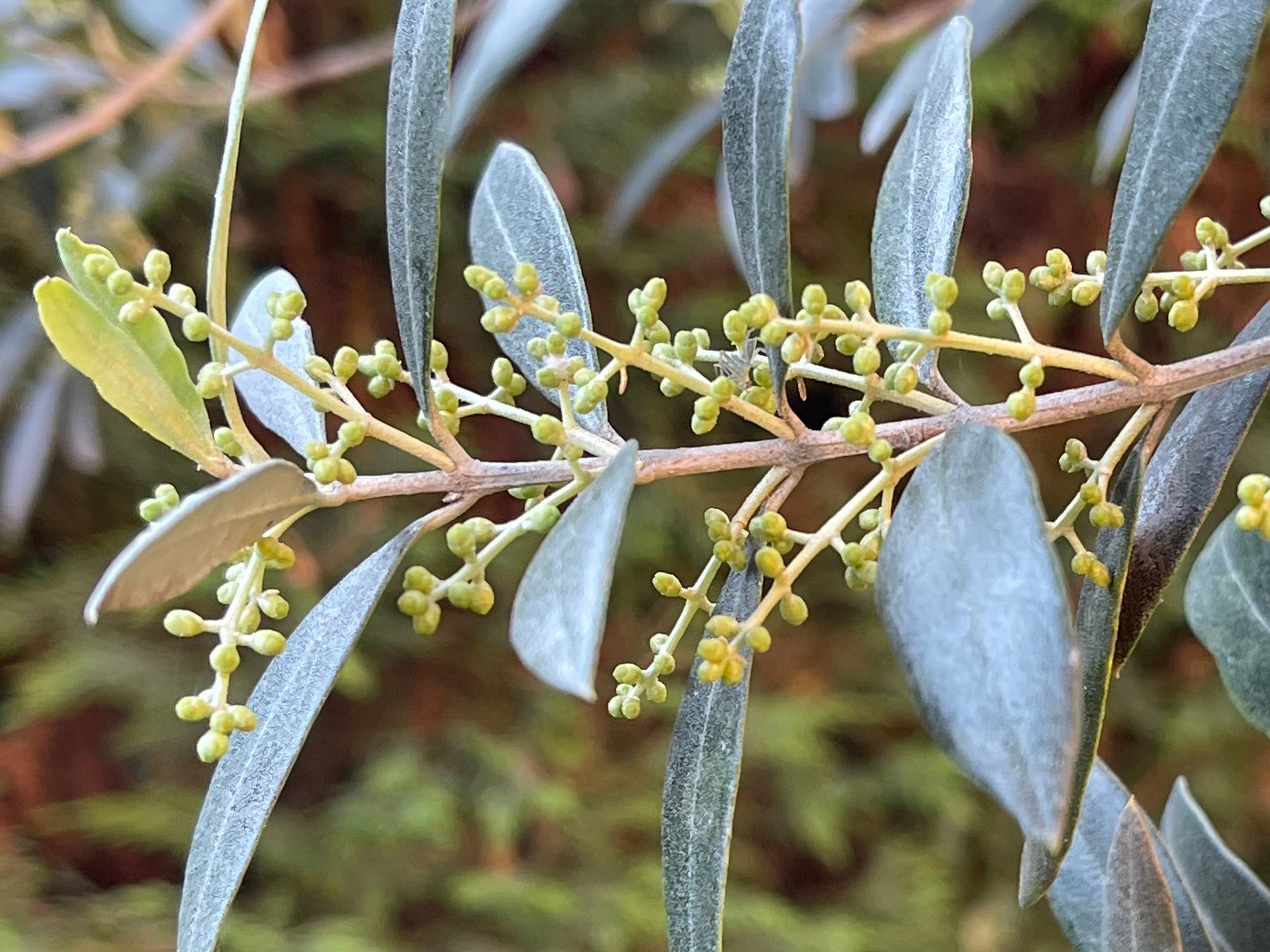
The idea of going to the olive grove to help my mind stay on a spreadsheet for longer feels absurd. At this time of year, I go to the olive grove to look at the tiny olive flowers and see how the trees are doing as the season changes. And that shift in attention - from the spreadsheet to those easily missed blossoms - feels worthwhile in its own right.
What the research doesn’t fully capture is that nature supports attention not only by increasing its capacity, but also by offering something meaningful to attend to.
Perhaps the question is not: How can I hold my attention for longer?
But rather:
What is worth paying attention to?